

Are Golf Courses Bad for the Environment?
Jan 20, 2026
Key Takeaways
Golf courses present a genuinely mixed environmental picture. They can cause real harm through water consumption, chemical runoff, and habitat destruction—but modern design and management practices are increasingly shifting the balance toward net environmental benefits.
- The main environmental concerns include high water consumption (U.S. courses use approximately 1.5 billion gallons daily), pesticide and fertilizer runoff that can harm aquatic life, habitat loss from construction on undeveloped land, and carbon emissions from maintenance equipment and operations.
- Well-managed courses deliver measurable benefits including urban cooling (surface temperatures 6-10°F lower than surrounding neighborhoods), wildlife habitat preservation, stormwater management, and carbon sequestration—particularly valuable in urban environments with limited green space.
- Real-world success stories exist: Courses certified through programs like Audubon Cooperative Sanctuary have documented increased biodiversity, reduced chemical inputs, and significant water conservation. In New York alone, 36% of courses reduced irrigation over five years, removing nearly 1,800 acres from watered areas.
- Context matters significantly: Research shows golf courses provide higher ecological value in 94% of cases when compared to highly urban land, but the environmental case becomes less clear when courses replace pristine natural areas like wetlands or forests.
- From Matize Golf’s perspective, we believe style and environmental stewardship go hand in hand. We support courses, clubs, and golfers who prioritize sustainable practices—because the future of golf depends on respecting the landscapes we play on.
- Are Golf Courses Bad for the Environment? (Short Answer)
The honest answer is: it depends. Whether golf courses are bad for the environment hinges on where they’re built, how they’re designed, and how they’re managed day-to-day.
Historically, particularly from the 1960s through the 1990s, many golf courses earned their environmental criticism. Heavy pesticide applications, excessive water consumption, and the destruction of wetlands and native habitats were common practices. Courses were designed for aesthetic perfection rather than ecological function, and the environmental costs were largely ignored.
Since the 2000s, this picture has shifted considerably. Regulations like the EU Water Framework Directive and the U.S. Clean Water Act have pushed many courses toward more responsible practices. Industry standards have evolved, and environmental programs from organizations like the USGA and Golf Course Superintendents Association of America (GCSAA) have established clear best practices for environmental stewardship.
The concept of “net impact” is crucial here. A golf course built on previously pristine coastal dunes or old-growth forest represents a clear environmental loss. But that same course built on a former industrial site, landfill, or abandoned farmland might actually improve the local environment compared to what existed before. And compared to alternative development options like housing tracts, shopping centers, or parking lots, a golf course often provides substantially more ecological value.
Throughout this article, we’ll examine the major environmental concerns around golf courses, explore the documented benefits, and discuss how golfers, clubs, and brands like Matize Golf can drive positive change.
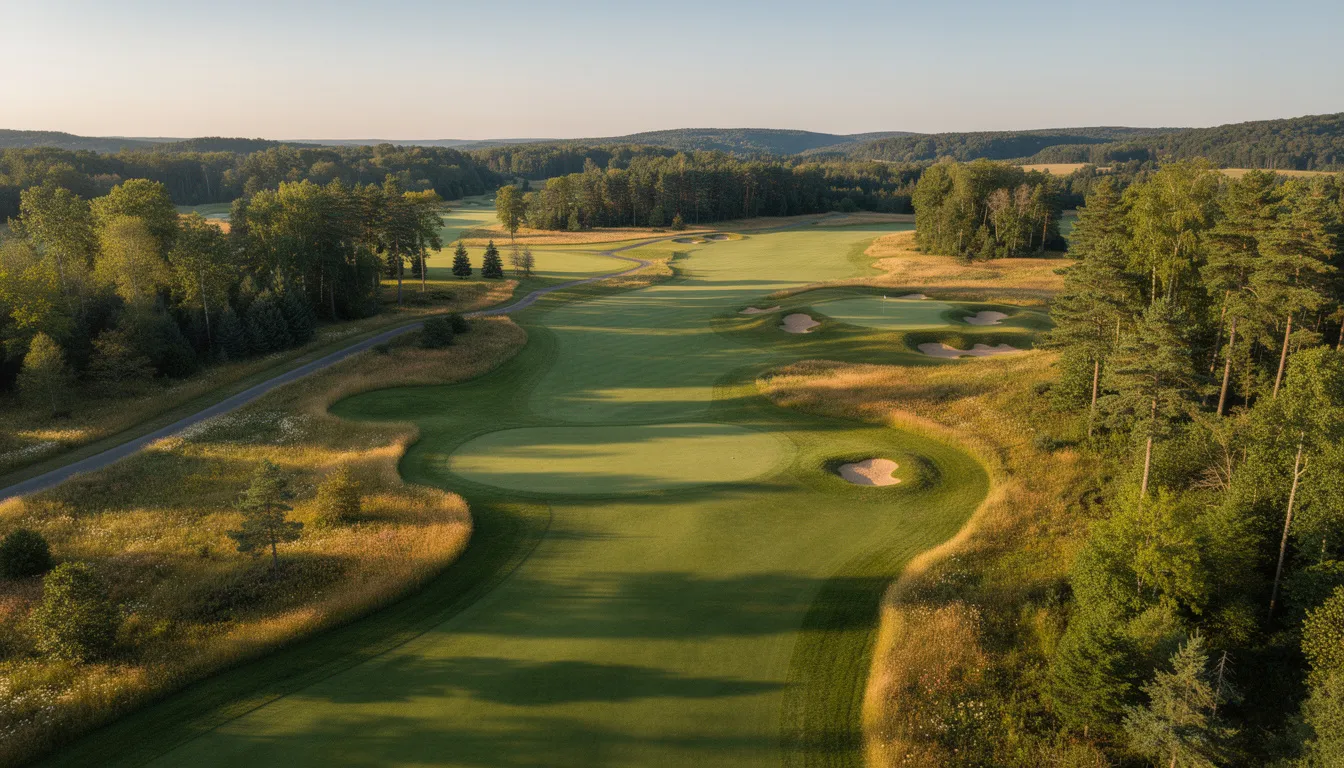
Major Environmental Concerns Around Golf Courses
Critics of golf courses typically focus on four main areas of concern, and it’s important to examine each honestly. Understanding these issues is the first step toward addressing them.
The primary environmental concerns include:
- Chemical pollution from pesticides, herbicides, and synthetic fertilizers
- Habitat loss and fragmentation when courses are built on undeveloped land
- Water consumption competing with municipal and agricultural needs
- Energy use and carbon footprint from maintenance, construction, and operations
These impacts are often magnified in environmentally sensitive locations. Courses built in arid regions like Arizona, Southern Spain, or the Middle East face acute water scarcity issues. Coastal developments can destroy dune ecosystems. Courses carved from forests fragment wildlife corridors. And wetland conversion eliminates some of the most biodiverse habitats on Earth.
That said, these concerns are not universal. Many existing golf courses now operate under strict environmental regulations and have adopted management practices that dramatically reduce their footprint. The challenge lies in distinguishing between poorly managed operations and those genuinely committed to environmental quality.
Pesticides, Fertilizers, and Water Pollution
Maintaining tournament-quality turf traditionally required significant chemical inputs. Fairways and greens rely on herbicides to control weeds, fungicides to prevent disease, insecticides to manage pests, and synthetic fertilizers to maintain that iconic green color. This creates a maintenance-intensive ecosystem that doesn’t exist naturally in most climates.
The environmental risk comes from runoff. When chemicals are applied to turf, they can migrate into nearby streams, ponds, and groundwater. Nitrogen and phosphorus from fertilizers contribute to algal blooms that deplete oxygen and harm aquatic life. Pesticide residues can accumulate in sediments and affect wildlife up the food chain.
Modern golf course superintendents have largely moved away from blanket spraying and over-fertilization. According to the New York Golf Economic & Environmental Impact Report (2025), more than 95% of courses now use at least four integrated pest management (IPM) practices, with 75% using six or more. Specific adoption rates include:
|
Practice |
Adoption Rate |
|---|---|
|
Chemical rotation to prevent resistance |
97% |
|
Routine scouting for early detection |
88% |
|
Spot treatments instead of blanket applications |
81% |
|
Forecast-based timing |
80% |
|
Mechanical controls with record-keeping |
73% |
These practices represent significant progress. Fertilizer is now applied to only 56% of total course acreage in New York, and 27% of courses have further reduced their fertilized area in the past five years. Native vegetation buffer zones around water features help filter runoff before it reaches sensitive habitats.
The challenge remains that older courses or those with less stringent management may continue problematic practices, and the regulatory landscape varies significantly by region.
Habitat Loss, Fragmentation, and Landscape Change
An 18-hole golf course typically uses 100-200 acres (40-80 hectares) of land. When that land was previously undeveloped forest, dunes, or wetlands, the construction process can drive major habitat loss.
The Marapendi golf course in Brazil provides a concrete case study. According to the Group of Specialized Expertise on the Environment (GAEMA), the development caused “fragmentation of the native vegetation and eliminating the salt marsh ecosystem.” While the land had already been partially degraded from sand extraction, the course construction completed the transformation from natural areas to managed landscape.
Beyond direct habitat loss, golf course development can fragment wildlife corridors. Fairways, cart paths, and maintained rough create barriers that disrupt animal movement, nesting sites, and foraging patterns. This is particularly problematic for species that need connected habitat to maintain viable populations.
The good news is that many jurisdictions now require environmental impact assessments before approving new courses built on sensitive land. Mitigation plans often mandate habitat restoration, conservation easements, or creation of no-play zones that provide wildlife sanctuaries within the course boundary.
Redesign and restoration projects on existing golf courses can also repair earlier damage. Converting unnecessary managed turf to native rough, establishing riparian buffers along streams, and creating “no-mow” conservation zones all help rebuild biodiversity on courses where it was previously lost.
Water Consumption and Drought Stress
Water consumption is perhaps the most visible environmental concern around golf courses, particularly in regions facing water scarcity.
U.S. golf courses collectively use approximately 1.5 billion gallons of water per day—roughly 0.5% of total U.S. water withdrawals. While this percentage may seem modest, the issue becomes acute in specific regions. Courses in Phoenix, Scottsdale, Palm Springs, and parts of the Middle East operate in desert climates where irrigation water competes directly with municipal supplies and agriculture.
During California’s severe drought in the 2010s, golf courses came under intense media scrutiny. Images of emerald-green fairways surrounded by brown, parched landscapes became symbols of resource inequality. Similar controversies have played out in Spain, where tourist-focused golf developments compete for water resources with local communities and farms.
The source of irrigation water matters significantly for environmental impact:
- Potable water diverts drinking-quality supplies from other uses
- Reclaimed wastewater (used by many courses in arid regions) reduces demand on freshwater sources
- Desalinated water has its own energy footprint but doesn’t deplete freshwater aquifers
- Captured stormwater can actually improve local hydrology by reducing flood risk
- The trend is encouraging. According to the New York data, 36.4% of courses reduced irrigation over five years, removing 1,807 acres from irrigation systems. Nearly 98% of courses employ water-saving strategies including advanced scheduling, soil moisture monitoring, wetting agents, and drought-tolerant turfgrasses.
Energy Use, Carbon Footprint, and Resource Inputs
Environmental impact extends beyond land and water resources to include energy consumption and greenhouse gases. Golf courses require significant fuel for mowers, utility vehicles, and maintenance equipment. Electricity powers irrigation pumps, clubhouse facilities, and lighting. And the construction phase involves embodied carbon in materials like concrete, steel, and synthetic turf components.
The maintenance cycle is intensive. Regular mowing of fairways, greens, and rough; bunker raking; leaf blowing; and constant equipment operation all consume fuel and generate emissions. Add fertilizer production and transport, and the carbon footprint grows further.
Waste issues compound the problem. Single-use plastics from tees, water bottles, and food packaging accumulate. Clubhouse operations generate food waste. Poorly managed landscaping debris ends up in landfills rather than composted.
For destination courses, the environmental equation includes golf tourism itself. Long-distance flights to bucket-list courses contribute significantly to golf’s overall climate impact—often dwarfing the operational footprint of the course itself.
Progressive clubs are responding with electric maintenance equipment, solar panels on facilities, improved waste management, and reduced-input maintenance regimes. But adoption remains uneven across regions and budget levels.
Can Golf Courses Be Good for the Environment?
Framing golf courses exclusively as environmental problems misses half the picture. When designed and managed with ecology in mind, courses can function as valuable green infrastructure—delivering environmental services similar to urban parks while providing recreation.
The USGA research identifies several documented benefits: golf courses help cool developed areas during hot weather, provide habitats for native wildlife and vegetation, support threatened species, manage stormwater runoff to prevent flooding, recharge groundwater supplies, filter surface runoff, sequester atmospheric carbon, and improve air quality.
These benefits are especially significant in urban areas. Research cited by the USGA found that residential, industrial areas, and roads showed surface temperatures of 95-98.6°F, while golf courses maintained temperatures around 89°F—meaningfully cooler than even average green space at 91°F.
The context matters enormously. A study examining ecological values across different land types found golf courses provided higher ecological value in:
|
Prior Land Use |
Cases Where Golf Provides Higher Ecological Value |
|---|---|
|
Highly urban land |
94% |
|
Residential land |
84% |
|
Agricultural land |
69% |
|
Parkland |
44% |
In other words, in highly urbanized areas with limited alternatives, golf courses provide disproportionate environmental benefits. In less-developed areas, the trade-offs are more complex.
Wildlife Habitat and Biodiversity Potential
The 37% of golf course land that consists of water, wetlands, trees, forests, and native rough represents significant habitat potential in developed landscapes. Roughs, out-of-play areas, ponds, and woodlots can function as refuges for birds, pollinators, amphibians, and other wildlife when managed appropriately.
Many courses have expanded native plantings since around 2000, recognizing that native vegetation has “more value for insects, birds and other wildlife” compared to maintained turf. The USGA explicitly recommends converting unnecessary managed turf to native vegetation and making space for threatened plant and animal species through habitat cultivation.
Courses certified through programs like Audubon Cooperative Sanctuary have documented measurable improvements in species richness and nesting success. Practical steps include:
- Reducing mowing frequency in out-of-play areas
- Planting native wildflower corridors between holes
- Installing bat boxes and bird nesting structures
- Creating chemical-free buffer zones around water bodies
- Maintaining dead trees (snags) for cavity-nesting species
Nearly 90% of New York courses now implement four or more pollinator protection best management practices, with 64% adopting six or more. This demonstrates that biodiversity-friendly management has become mainstream in the industry.
The economic incentive aligns with the environmental one: less mowing, fewer chemicals, and reduced irrigation in out-of-play areas all reduce maintenance costs while enhancing wildlife habitats.
Water Conservation and Smarter Irrigation
Modern irrigation technology has transformed what’s possible for water conservation on golf courses. Soil moisture sensors, weather-based controllers, and zone-specific sprinklers can cut water use by 20-30% compared with older systems.
U.S. courses have reduced irrigation needs by roughly 19-30% since the mid-2000s, depending on the study cited. The New York data shows this trend continuing, with substantial acreage removed from irrigation systems entirely.
Drought-tolerant turfgrass varieties are central to this progress:
- Bermuda grass and paspalum in warm climates survive extended dry periods
- Fine fescues in cooler climates require less water than Kentucky bluegrass
- Native grass roughs need no irrigation at all once established
Many courses in arid regions now use recycled water or treated wastewater for irrigation. This diverts effluent from disposal while reducing demand on potable water supplies. Others capture stormwater from surrounding neighborhoods into storage ponds, turning a drainage problem into an irrigation solution.
Visible changes in course aesthetics—firmer fairways, browner rough in summer, less uniform green coloring—are increasingly signs of responsible water stewardship rather than neglect. Golfers should recognize these as features, not bugs.
Water Quality Improvement and Stormwater Management
Dense turf and underlying soil can function as environmental filters, trapping sediments, nutrients, and some pollutants from stormwater runoff before it reaches aquifers or rivers. This filtering capacity represents one of golf’s underappreciated environmental contributions.
Design features enhance this benefit:
- Vegetated swales slow runoff and allow infiltration
- Retention ponds hold stormwater during peak flows and release it gradually
- Wetland buffers provide biological treatment of runoff
- Constructed wetlands support ecosystems while managing water quality
- Suburban courses that accept runoff from surrounding housing developments can reduce local flood risk significantly. This function saves municipalities money by reducing the need for expensive drainage and flood-control infrastructure.
The critical caveat: this benefit depends entirely on responsible chemical use. Courses that over-apply fertilizers and pesticides can overwhelm the filtering capacity, turning what should be an environmental asset into a pollution source. Integrated pest management and careful nutrient budgeting are essential for courses to deliver genuine water quality benefits.
Urban Cooling, Air Quality, and Carbon Sequestration
The urban heat island effect makes cities significantly warmer than surrounding rural areas, with serious implications for public health, energy consumption, and quality of life. Large, vegetated green spaces like golf courses help counteract this effect.
Research from Minneapolis-St. Paul found that “golf courses provided the greatest amount of cooling relative to other green infrastructures.” The cooling effect extends several hundred meters beyond course boundaries, benefiting surrounding neighborhoods with reduced heat stress and lower air conditioning demand.
Carbon sequestration provides another climate benefit. Turf, trees, and shrubs on courses store carbon in biomass and soils. Research indicates high sequestration during the first 25-35 years after establishment, though rates can plateau for turfgrass. Mature trees and native plantings typically store carbon more efficiently and require fewer inputs than intensively managed greens and fairways.
Air quality benefits round out the picture. Vegetation traps dust and particulates while producing oxygen—especially valuable in dense urban and suburban regions with traffic pollution. The USGA notes this benefit is “well-documented,” particularly in areas with “high incidences of asthma and other breathing disorders.”
How Golf Communities and Courses Are Becoming More Eco-Friendly
Many clubs and real-estate communities now view environmental credentials as a selling point rather than merely a regulatory burden. This shift reflects changing member expectations, potential cost savings, and genuine commitment to environmental conservation.
Industry initiatives have proliferated:
- USGA and GCSAA environmental programs provide research-based guidance
- Audubon Cooperative Sanctuary Program certifies courses meeting habitat and management standards
- GEO Certified offers international recognition for sustainable golf operations
- National and regional schemes in Europe and Asia address local environmental priorities
Green building standards like LEED and BREEAM increasingly influence clubhouse construction and renovation. Landscape architecture guidelines incorporate ecological principles into course design from the earliest planning stages.
The business case is compelling. Eco-friendly practices improve course resilience to climate extremes—drought, flooding, heat stress—while reducing long-term operating costs. Environmentally conscious members, particularly younger golfers, increasingly factor sustainability into their club choices.
Examples of Sustainable Course Management in Practice
Concrete examples demonstrate what’s achievable when courses commit to environmental stewardship.
Heron Glen and Quail Brook (New Jersey): These municipal courses have implemented comprehensive best practices including native rough conversion, reduced chemical inputs, and habitat enhancement. They demonstrate that public courses with limited budgets can achieve meaningful environmental improvements.
Arizona desert courses: Many Phoenix-area courses now use 100% reclaimed water for irrigation, dramatically reducing pressure on scarce groundwater supplies. Course designs incorporate native desert landscaping that requires no supplemental irrigation, reserving water for playing surfaces only.
European resort restorations: Several Mediterranean golf developments have restored dunes and wetlands as part of course redesigns, reversing damage from earlier construction and creating genuine wildlife sanctuaries within the course footprint.
Practical measures driving these improvements include:
- Converting out-of-play turf to native rough (reducing mowing and irrigation)
- Switching to electric maintenance fleets (eliminating emissions and noise)
- Installing solar arrays on maintenance facilities (offsetting energy consumption)
- Composting green waste (eliminating landfill disposal)
- Implementing comprehensive integrated pest management (reducing chemical dependence)
Golf course superintendents increasingly view themselves as environmental stewards with specialized training in ecology, soil science, and water management—not just turf managers focused on aesthetics. Professional certifications now include substantial environmental components, and continuing education emphasizes sustainable practices.
Community engagement builds local support. Nature walks, school visits, bird counts, and public reporting of environmental performance help neighbors understand courses as environmental assets rather than threats.
What Can Golfers, Clubs, and Brands Do to Support Greener Golf?
Sustainability in golf is a shared responsibility. Progress requires action from players, course operators, governing bodies, equipment manufacturers, and the apparel companies that outfit the game.
For individual golfers:
- Choose courses with environmental certifications or documented sustainability practices
- Respect marked wildlife areas and stay on cart paths through sensitive zones
- Accept less “perfect” but more natural playing conditions—firm fairways and naturalized rough are often signs of responsible management
- Minimize personal waste and water use on the course
- Ask questions about environmental practices when booking tee times or considering memberships
For clubs and course operators:
- Conduct environmental audits to establish baseline performance
- Set measurable targets for water consumption, chemical use, and energy reduction
- Transition to renewable energy where feasible
- Prioritize native landscaping in redesigns and renovations
- Partner with local conservation organizations for expertise and credibility
- Report environmental performance publicly to build member and community trust
For the broader golf ecosystem:
Collaboration multiplies impact. Clubs partnering with conservation NGOs gain access to expertise and legitimacy. Governing bodies can incentivize sustainable practices through tournament site selection and facility requirements. And brands across the industry can use their platforms to highlight sustainable courses and practices.
Matize Golf’s View: Style, Sustainability, and the Future of the Game
At Matize Golf, we approach golf from a perspective that values both heritage and progress. Based in Portugal, we’ve built a brand around stylish, quality apparel that works on and off the course. But we also recognize that golf faces real environmental challenges—and meaningful change requires commitment across the entire sport.
Our approach to sustainability starts with materials and construction. We prioritize organic and recycled fibers where possible, build garments for durability rather than disposability, and design versatile pieces that reduce the need for overconsumption. A polo that works for your Saturday round and your Sunday brunch means fewer items in your closet and less overall environmental impact.
We also believe in supporting the courses and clubs that share our environmental focus. When we work with clubs and organizations on customized apparel for events and memberships, we’re especially proud to partner with those prioritizing eco-friendly practices.
Sustainability is becoming part of modern golf style. Choosing apparel and courses that reflect respect for landscapes—not just performance or prestige—signals a commitment to the game’s future. The golfers who care about where their clothes come from are often the same ones asking whether their courses conserve water and protect wildlife habitats.
We invite you to explore Matize Golf collections and consider how your wardrobe choices can align with your environmental values. Because looking good and doing good aren’t mutually exclusive.
Final Thoughts: So, Are Golf Courses Bad for the Environment?
The answer is genuinely nuanced: golf courses can be environmentally damaging when poorly sited and managed, but they can also function as valuable green infrastructure when designed with ecology in mind.
The main trade-offs are clear. Golf courses consume land and water resources that might otherwise support natural habitats or other uses. They require ongoing inputs of energy, chemicals, and materials. And when built on sensitive ecosystems, they cause lasting environmental harm.
But golf courses also provide urban cooling in a warming world. They offer wildlife habitat in landscapes dominated by pavement and buildings. They manage stormwater that would otherwise flood communities. They sequester carbon and improve air quality. In the right context with the right management, the positive impact can outweigh the costs.
The trend is encouraging. Increasing regulation, evolving turf science, and changing golfer expectations are all pushing the industry toward more sustainable models. Golf course superintendents have embraced their role as environmental stewards. And courses that once symbolized excess are increasingly demonstrating genuine environmental leadership.
Golf must continue to adapt. Climate change and resource constraints will only intensify the pressure to do more with less—less water, fewer chemicals, reduced energy consumption. Players, clubs, and brands like Matize Golf all have roles in steering that transition.
Imagine future courses that feel more like nature reserves you can play through—where heritage golf culture meets progressive environmental design. Where the rough hosts native wildflowers and the ponds support ecosystems. Where the playing experience connects golfers to the natural world rather than separating them from it.
That future is possible. It’s already emerging on courses around the world. And every choice we make—from the tee times we book to the apparel we wear—contributes to making it a reality.

Frequently Asked Questions About Golf Courses and the Environment
Are some sports more damaging to the environment than golf?
Environmental impact varies significantly depending on which metrics you prioritize. Motorsports generate higher direct carbon emissions from fuel combustion. Ski resorts can alter entire mountain ecosystems through forest clearing, artificial snowmaking, and infrastructure development. Large stadium events generate massive waste and transport emissions for each match or concert. Golf is particularly impactful in terms of land use and water consumption, but calling it “the most damaging” sport oversimplifies a complex comparison. The key is that every sport has environmental trade-offs, and the goal should be improving practices across all of them.
How can I tell if a golf course is environmentally friendly before I book a tee time?
Look for certifications like Audubon Cooperative Sanctuary, GEO Certified, or regional equivalents—these require documented environmental standards. Check the course website for sustainability pages or environmental policies. Review course photos for evidence of native landscaping, naturalized roughs, and wildlife habitat areas. If information is limited, call the pro shop and ask directly: Where does your irrigation water come from? Do you use integrated pest management? Have you reduced chemical inputs in recent years? Environmentally committed courses are usually happy to discuss their practices.
Do environmentally friendly courses play worse than traditional ones?
Not necessarily—they simply play differently. Eco-friendly courses may feature more naturalized rough (meaning errant shots have real consequences), firmer and faster fairways (rewarding accurate driving), and less uniform green coloring (reflecting responsible water use rather than neglect). Many golfers find these conditions more interesting and strategic than manicured perfection. Traditional links courses in Scotland and Ireland have always offered this aesthetic, and they’re among the most celebrated in golf. Playing quality depends on design, conditioning philosophy, and maintenance skill—not on whether a course uses more or fewer chemicals.
Is building new golf courses ever a good environmental idea?
New course construction is most defensible when it converts degraded or previously developed land—brownfields, abandoned industrial areas, former landfills, or exhausted agricultural land—into multifunctional green space. In these cases, the course may actually improve local environmental quality compared to prior conditions. Projects that include robust habitat restoration, comprehensive water management plans, and conservation easements can create net environmental benefits. What’s rarely justifiable is converting pristine ecosystems—old-growth forests, coastal wetlands, intact dune systems—into golf courses, regardless of how sustainable the subsequent management might be.
What role can golf apparel brands realistically play in reducing the game’s environmental impact?
Apparel brands influence materials, supply chains, manufacturing practices, and consumer expectations. Brands committed to sustainability—like Matize Golf—can prioritize durable construction over fast-fashion disposability, use lower-impact materials like organic cotton and recycled synthetic fibers, ensure ethical manufacturing conditions, and design versatile pieces that reduce overall consumption. Beyond products, brands have platforms to highlight sustainable courses, support educational initiatives, and shape golfer attitudes about what “good golf” looks like. When golfers start expecting sustainability from their apparel, they often extend those expectations to courses and clubs as well.

